IFC Viewer Online · Back to the BIM & IFC blog
Delivery & ISO 19650 · 2026-11-12 · 6 min
Who Approves Your Company's BIM Rules? Versions, Review and Who a Change Affects
When one person edits the company ruleset on a Friday, fifteen subcontractors check against it on Monday. A preview of a rule library with versions, approval by someone other than the author, and the effect of a change on the model.
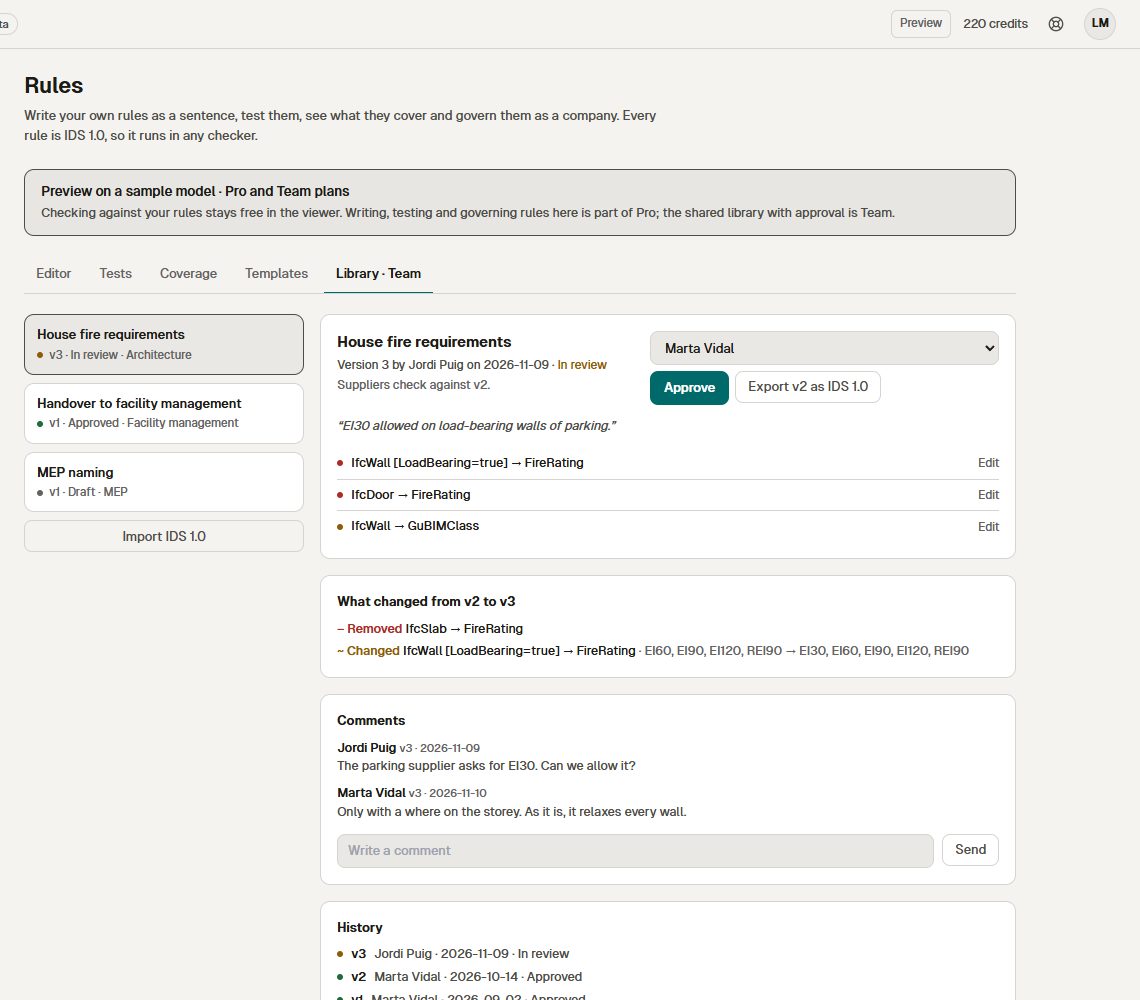 Company rule library: a ruleset in review, what changed from the previous version, comments and history
In most firms the checking rules live in one person's head, or in a file that one person edits. That works until someone relaxes a rule for one project and every other project inherits it, or until a subcontractor asks which version of the requirements they were checked against and nobody can say.
Writing a rule well is one problem (we cover it in writing and testing your own rules). Governing who changes the company's rules, and when, is another.
Key takeaways
- Every ruleset has versions, an author and a state: draft, in review, approved.
- The author of a version cannot approve it.
- Before a change is approved, you see which elements start or stop failing on a real model.
- Subcontractors always check against the approved version for the current stage.
Versions, authors and a review
Each company ruleset (house fire requirements, the handover to facility management, MEP naming) has numbered versions. A new version starts as a draft, goes to review and is approved or sent back. The screen shows what changed between versions (a rule removed, a list of allowed values widened), the comments of the reviewers and the history.
 Design preview with sample data, Spanish interface. Suppliers keep checking against version 2 until version 3 is approved.
In the example, version 3 removes the slab fire-rating rule and adds EI30 to the walls. The author explains why (the parking supplier asks for EI30) and the reviewer replies that it should only apply with a condition on the storey. That conversation stays next to the version.
The author does not approve their own work
It is a simple rule and it is the one that matters most. If the person who wrote version 3 tries to approve it, the library refuses.
 Design preview with sample data, Spanish interface.
Before you change a rule, see who it affects
A text diff says what changed in the rule. It does not say what changes in the model. Before approving, the library runs both versions on the same model and lists the elements that start failing and the ones that stop failing. Relaxing a rule stops being a guess.
 Design preview with sample data, Spanish interface.
One library, with the stage on each rule
The usual way to handle ISO 19650 stages is one ruleset per stage, which means copying rules and keeping the copies in step. Here each rule carries the status where it applies (S1 to S4, A), and the library gives each stage only the rules that count.
What subcontractors get
The rules are of little use if suppliers only see them as a PDF. The library produces a requirements link with the IDS of the approved version for the current stage. Suppliers open it, drop their IFC and see whether you will accept it, for free and with no account; the file never leaves their computer. That link exists today and is free; reviewing subcontractor models explains how it fits in the receiving side.
One honest note: geometric rules (door clearance, clear height) stay in your workspace, because they need the model geometry. What travels in the link are data and relation rules.
How it compares
Solibri sells central company rules in its top plan. Prices from its official page, read on 12 November 2026. [solibri-pricing]
| Solibri Premium | IFC Viewer Online library (preview) |
|---|
| Central company rules | Yes | Yes |
| Approval by someone other than the author | Not stated on the pricing page | Yes, enforced |
| Effect of a change on the model | No | Yes, elements that start and stop failing |
| Stage per rule | Separate rulesets per stage | One library, stage on each rule |
| What suppliers need | A Solibri licence to run the rules | A link, free, no account |
| Price | €2,772/year per licence | Planned within Team, from €59 per editor per month (minimum 3 editors) |
Source: solibri.com/pricing, read on 12 November 2026. Our planned prices are on the pricing page.What you can already do for free
Create a requirements link with your rules, a minimum score and your ISO 19650 naming convention, and send it to your suppliers. Check any IFC against an IDS file. None of that changes.
Do several people maintain your rules?
If your firm has house rules that more than one person edits, and subcontractors who check against them, talk to us or join the waitlist. [ivo-pricing]
References
- Solibri pricing — Solibri. Plans and starting prices per licence per year, as published on 12 November 2026.
- IFC Viewer Online plans — IFC Viewer Online. Planned prices of the paid plans, which are not open yet.
Who Approves Your Company's BIM Rules? Versions, Review and Who a Change Affects