Back to the BIM & IFC blog
Digital twins · 2026-10-16 · 7 min
Digital Twin Maturity Levels, Shown on Live Examples
Descriptive, informative, predictive, comprehensive, autonomous: the five levels most maturity models use. Each one shown on a real, open example, and where an example does not reach a level, it says so. Plus how to tell which level a project actually needs.
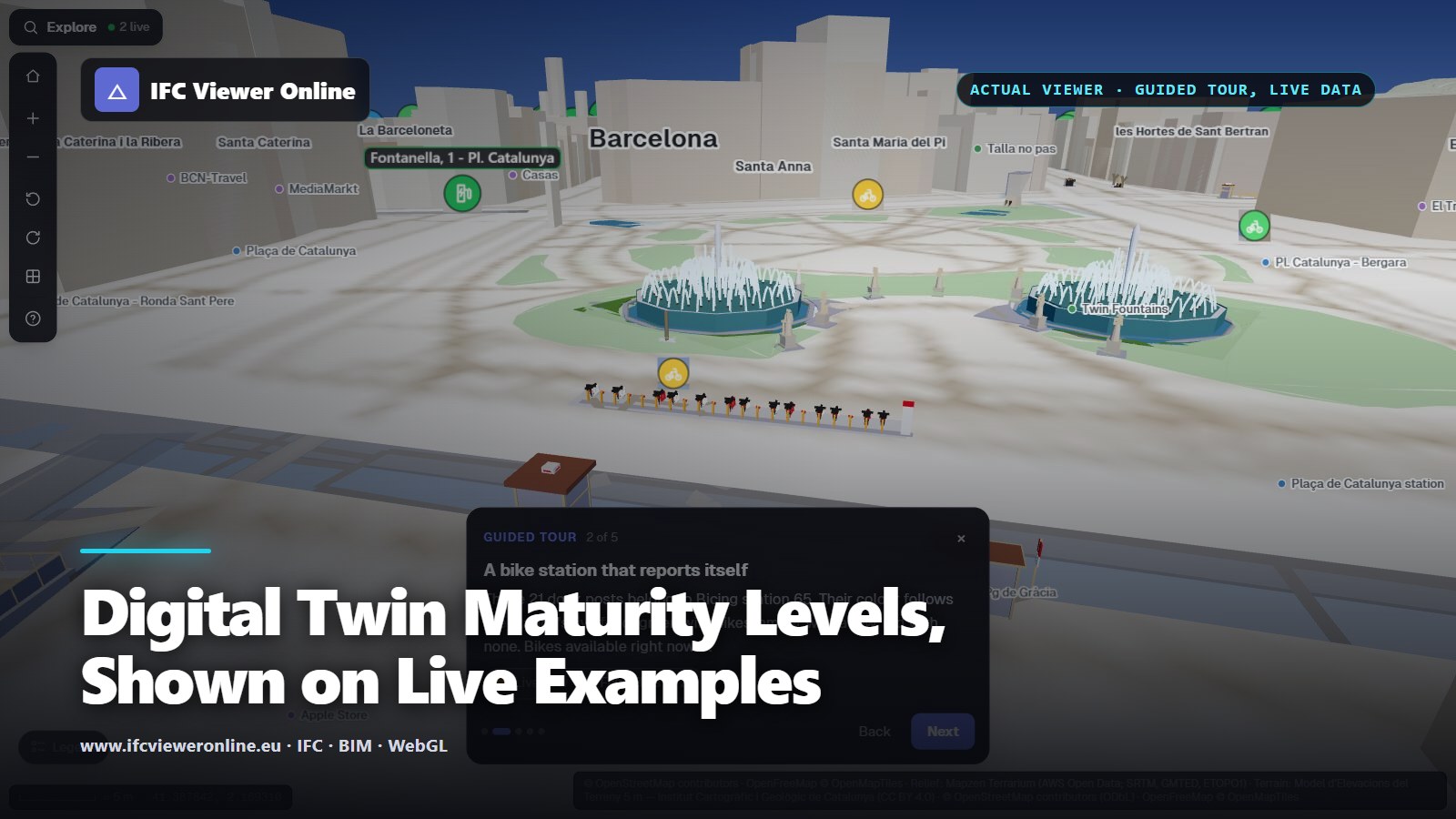 The Plaça de Catalunya digital twin in IFC Viewer Online with its guided tour open, explaining what the live data on the IFC models means
Ask what a digital twin is and you will get answers from "a 3D model" to "a system that runs the building by itself". Maturity levels sort that out: they say what a twin does, step by step, so that a project can say which step it needs and a vendor can say which one it delivers.
The ladder most people use has five levels, from Verdantix, and it is the one Autodesk adopts[tandem]. Below, each level is shown on a model you can open, and where the examples here do not reach a level, that is said plainly rather than dressed up.
Key takeaways
- Descriptive: the model of the asset, in its place. Informative: with live data on it. Predictive: forecasts from that data. Comprehensive: what-if scenarios. Autonomous: it acts on its own.
- The open examples here reach levels 1, 2 and 4: models on the real city, live open data on them, and sun and flood simulations.
- They do not forecast (level 3) and do not act (level 5). Saying so is part of using the ladder honestly.
- Pick the level a decision needs, not the highest one: every step costs data, integration and upkeep.
 The five levels, with the example that shows each one, or a plain "not here".
Level 1: descriptive
A live, editable model of the asset, placed where it really is. In practice, a BIM model with its real-world position and its surroundings: the eight IFC models of Plaça de Catalunya on Barcelona's terrain, with the city around them. It is what most projects have at handover, and what BIM vs digital twin calls step 2.
Level 2: informative
The same model with operational data on it: sensors, feeds, meters. The Barcelona square colours its bike dock posts from the Bicing feed, the Helsinki terminal its bays from live bus positions, the Tokyo entrance its signs from the line's status. This is the level where a twin starts to answer "what is happening now?", and the one the live examples in what an urban digital twin is are built around.
Level 3: predictive
Insights and forecasts drawn from the data collected: a dock that will run out of bikes in twenty minutes, a pump that will fail next month. The examples here record readings and draw them as trends, but they do not forecast. Prediction needs history, a model of the asset's behaviour and someone to validate it, and a public demo has none of those.
Level 4: comprehensive
What-if scenarios run on the model: what happens to this square at 6 pm in December, or in a storm of 40 mm an hour. Two of those run in the browser here: sun and shadow studies and a rain-flood simulation on an IFC model. Scenarios do not need the twin to be live; they need the model to be right.
Level 5: autonomous
A twin that learns and acts on its own: re-balancing bikes, changing a signal plan, switching a pump. None of the examples here does, on purpose. Acting on the real world needs authentication, an audit trail, safety limits and a person accountable for every automated decision, and a page anyone can open must not switch anything.
Which level does a project need?
| If the question is… | You need | What it takes |
|---|
| Where is everything, and what is it? | Level 1 | A clean, georeferenced model and its asset data |
| What state is it in now? | Level 2 | Feeds or sensors, bindings to the model, freshness rules |
| When will it need attention? | Level 3 | Recorded history, a behaviour model, validation |
| What would happen if…? | Level 4 | A simulation that runs on the model, with its limits stated |
| Can it act for us? | Level 5 | Control interfaces, safety limits, accountability |
Levels are not a race. A facility team that needs to find assets and see their state is well served at level 2, and a planning team at level 4 with no live data at all. Climbing a level is worth it when a decision depends on it.
Digital Twin Maturity Levels, Shown on Live Examples