Back to the BIM & IFC blog
Digital twins · 2026-10-16 · 8 min
How Fresh Is Real-Time City Data? Six Feeds, Measured for 24 Hours
"Real-time" says nothing about how old the data is when it reaches you. We logged six public feeds that live digital twins read, for 24 hours, and measured the age of every vehicle and station in them. The answer ranges from under a second to a minute and a half, and the feed's own timestamp can hide it.
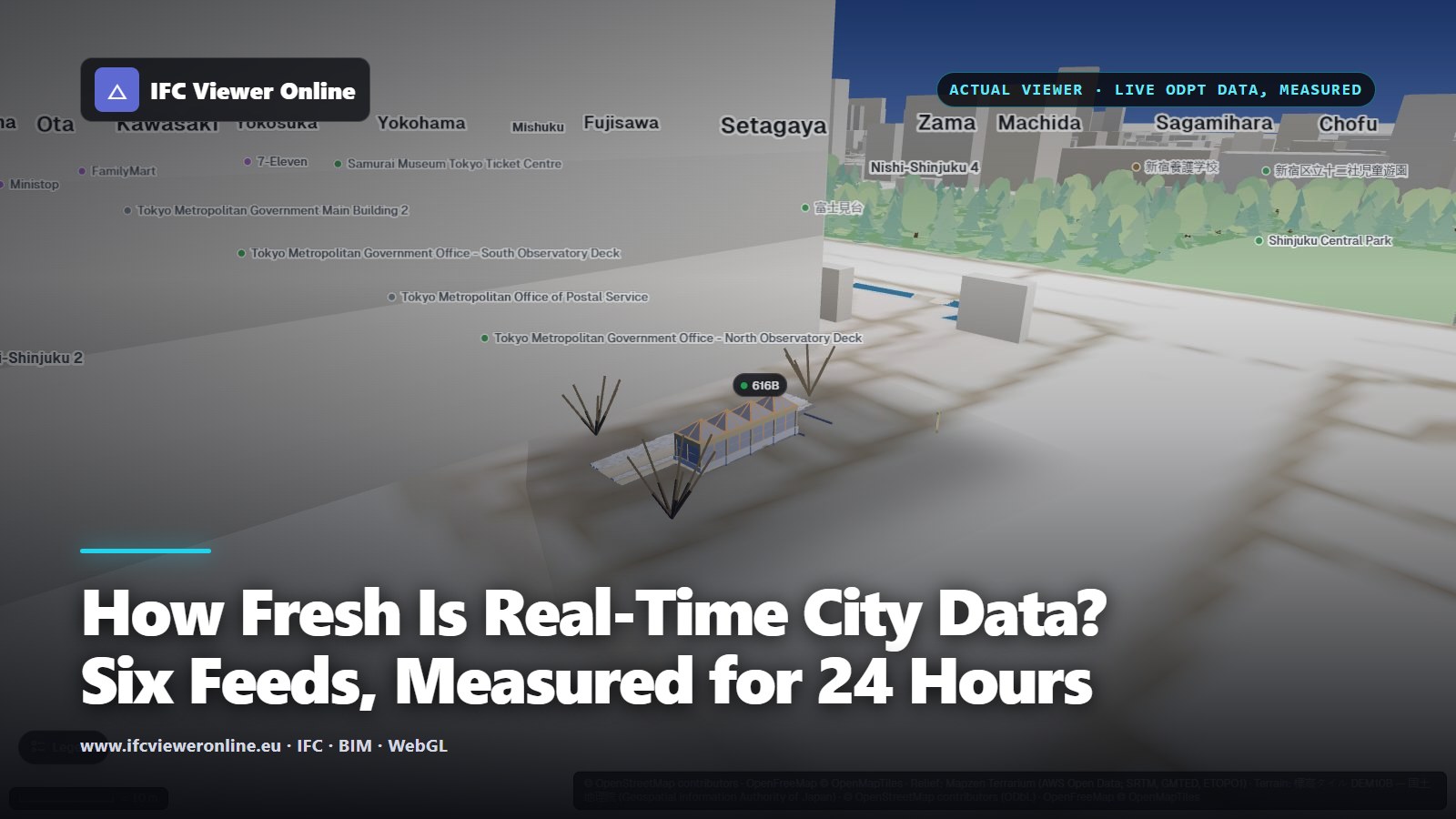 The Tochōmae station exit digital twin in IFC Viewer Online: the IFC model of exit A4 on the Tokyo map, with the live number of the Toei train at the platform floating over it
Every live feed calls itself real-time. For a digital twin, that word hides the one number that decides what its colours mean: how old the data is when it arrives. A bike dock painted red because it had no bikes three minutes ago is not the same as one that has none now.
So we measured it. For 24 hours we logged six public feeds that live twins read in Barcelona, Helsinki and Tokyo, and for every vehicle or station in every response we compared the time the publisher wrote with the time the data arrived. The full log is published[log].
Key takeaways
- HSL's MQTT stream arrived in under a second. The same fleet as GTFS-Realtime was about 2 seconds old, but browsers cannot read that feed.
- Toei train positions were about half a minute old. Toei bus positions and Bicing stations were about a minute and a half old at the median, up to about three minutes for 90% of them.
- A feed's own timestamp can mislead: Bicing's file was a third of a second old while the stations inside had reported about 95 seconds earlier.
- Endolla's charger feed has no time of report at all, only when each charger last changed, so how current it is cannot be shown.
- All 14,329 requests were answered, and the MQTT stream carried messages every minute of the day.
 Median age of the vehicles or stations in a typical response, and how far 90% of them reach.
How we measured
- From 21:15 UTC on 15 October to 21:15 UTC on 16 October 2026, on one computer in Europe with a synchronised clock.
- HSL GTFS-Realtime was polled every 15 seconds; Bicing and both Toei feeds every 30 seconds; Endolla every 5 minutes. HSL's MQTT stream was subscribed for the Helsinki area and summarised per minute.
- Per response we took the median and the 90th percentile over its vehicles or stations; the figure shows the typical value of those over the 24 hours.
Age is the arrival time minus the timestamp the publisher wrote for each item: the moment a vehicle's position was measured in GTFS-Realtime[gtfsrt], the last time a station reported in GBFS[gbfs], each message's own time in HSL's stream[hfp], and each train's record time in ODPT.
Feed by feed
| Feed | How it arrives | Median age | 90% of items under | Items per response |
|---|
| HSL buses, HFP (Helsinki) | MQTT, pushed | under 1 s | under 1 s | ~28,000 messages a minute |
| HSL vehicles, GTFS-Realtime (Helsinki) | HTTP, every 15 s; no CORS | 1.9 s | 1.9 s | 843 vehicles |
| Toei trains, ODPT (Tokyo) | HTTP, every 30 s | 28 s | 30 s | 92 trains |
| Toei buses, GTFS-Realtime (Tokyo) | HTTP, every 30 s | 88 s | 3.1 min | 490 buses |
| Bicing stations, GBFS 3.0 (Barcelona) | HTTP, every 30 s | 95 s | 2.8 min | 543 stations |
| Endolla chargers, GELFS (Barcelona) | HTTP, every 5 min | not stated | not stated | 1,366 connectors |
Typical values over 24 hours, 15–16 October 2026. Item counts are medians; Toei runs no trains or buses in the small hours.Three groups come out. HSL publishes what each bus says as it says it, so the age is close to zero over MQTT and about two seconds through its batched GTFS-Realtime file. Toei's train records were typically about half a minute old. Toei's buses and Bicing's stations report every few minutes each, so at any moment about half of them are older than a minute and a half: 49% of buses and 52% of stations were over 90 seconds old.
The timestamp that says "fresh"
Bicing's station status file carries a last_updated time, and it was always within a second of now: the file is stamped when it is served. The 543 stations inside it had reported a median 95 seconds earlier. A twin that trusted the file's time would show "updated 0 s ago" over data a minute and a half old. Toei's bus feed shows the same pattern, milder: the file's timestamp was about 16 seconds old, its buses about 88.
The lesson is simple: age is a property of each item, not of the file. Read the time each vehicle or station reports, and show that.
The feed that cannot say
The size of Endolla's charging-point file changed in 262 of 286 five-minute intervals, so it is clearly maintained. But each connector carries only the time its state last changed: half of them had not changed in about 21 hours, a tenth in more than 10 days. That may be perfectly accurate, a charger nobody used overnight, or a charger that stopped reporting; the feed cannot tell the two apart. A twin can show such data as "as published", never as live.
Push versus poll
HSL's two channels carry the same buses. Over MQTT each position arrives as it happens; through the polled file it waits for the next batch, and the browser waits for its next poll on top of that. Polling also costs: the Bicing file is about 268 KB before compression for all 543 stations, so a twin that needs one station still downloads all of them on every poll. Polling faster than the source changes only spends that bandwidth twice.
What it means for a twin
- Show the age next to the value, from the item's own timestamp, not the file's.
- Set the stale threshold above the feed's normal age. The live examples here use 45 seconds for HSL bus bays, 2 minutes for Toei trains, 10 minutes for the Toei bus stop and 15 minutes for Bicing.
- Grey means "no recent data", never the last value dressed as current.
- Prefer push where the publisher offers it; poll no faster than the source changes.
- A feed without a time per item can be shown, but not called live.
Whether a web page may read each of these feeds at all is the other half of the question: which city open data a web page can read. How the Helsinki twin uses the MQTT stream is in the bus terminal twin over MQTT.
How Fresh Is Real-Time City Data? Six Feeds, Measured for 24 Hours