Back to the BIM & IFC blog
Tools & comparisons · 2026-10-03 · 9 min
IFC 4.3 Explained: Bridges, Roads, Railways and Alignments
IFC 4.3 is the release that took IFC out of buildings. Bridges, roads, railways and ports are now first-class facilities, positioned along alignments instead of on storeys. What changed, what it means for the models you receive, and what to check when the first IFC4X3 file lands on your desk.
 IFC 4.3 Explained: Bridges, Roads, Railways and Alignments — IFC Viewer Online article cover
For most of its life, IFC was a building format. Roads, bridges and railways were modelled in other tools, exchanged in other formats, or forced into IFC as buildings with very long storeys. IFC 4.3 — published as ISO 16739-1:2024 — ends that.
If you work on infrastructure, it is the version that finally describes your projects. If you work on buildings, it still matters: it is the current version, and some names you rely on changed.
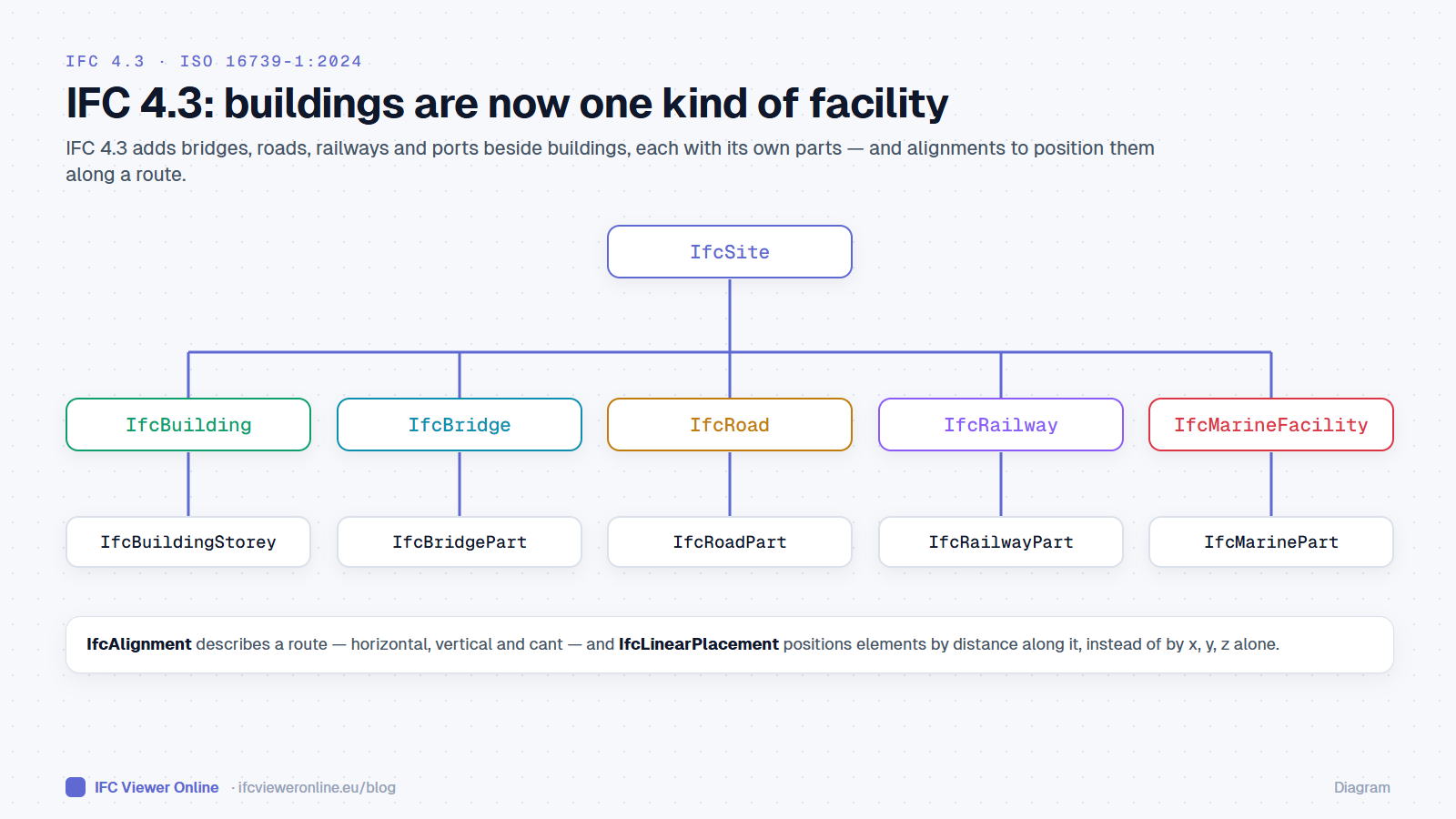 In IFC 4.3, a building is one kind of facility. Bridges, roads, railways and marine facilities sit beside it, each with its own parts.
Try it: an IFC 4.3 bridge
The buildingSMART IFC 4.3 sample bridge: a deck on piers, modelled as IfcBridge with its parts instead of storeys.
Open the interactive IFC viewer
Key takeaways
- IFC 4.3 adds infrastructure facilities — bridge, road, railway, marine — beside the building.
- Alignments describe a route; linear placement positions elements by distance along it.
- Files declare FILE_SCHEMA IFC4X3. Some names changed: IfcBuildingElement is now IfcBuiltElement.
From storeys to facility parts
Buildings are organised by storeys. A road is not — it is organised by sections along its length, and a bridge by its structural parts. IFC 4.3 generalises the spatial structure so each facility has the kind of part that makes sense for it:
| Facility | Parts | Typical elements |
|---|
| IfcBuilding | IfcBuildingStorey | Walls, slabs, doors, spaces |
| IfcBridge | IfcBridgePart (deck, pier, abutment…) | Beams, bearings, piers |
| IfcRoad | IfcRoadPart (carriageway, shoulder…) | Pavement layers, kerbs, signs |
| IfcRailway | IfcRailwayPart (track structure…) | Rails, sleepers, ballast |
| IfcMarineFacility | IfcMarinePart | Quay walls, fenders, mooring |
The general idea — aggregation for the spatial tree, containment for the elements — is the same as for buildings; it is explained with diagrams in the IFC spatial structure explained.
Alignments and linear placement
Infrastructure is described along a route. IfcAlignment carries the horizontal geometry (lines, arcs, transition curves), the vertical profile and, for railways, the cant. Elements can then be positioned with IfcLinearPlacement — "at chainage 1+250, 3.5 m left of the centreline" — rather than only by x, y and z. That is how engineers think about a road, and it survives the alignment being redesigned.
What changed for building models too
- IfcBuildingElement is now IfcBuiltElement. Tools and IDS specifications that hard-code the old name miss elements in IFC4X3 files.
- Georeferencing matters more. Infrastructure is large and long; a model without proper IfcMapConversion is unusable at that scale.
- The schema declared in the header is IFC4X3. Check it before you check anything else — the same rule set can behave differently across versions.
How the header, the schema and the entity names fit together in a file is shown in what's inside an IFC file.
Checking the first IFC4X3 file you receive
- Confirm the schema FILE_SCHEMA should say IFC4X3. Some exporters still write IFC4 with infrastructure squeezed into building entities.
- Read the spatial tree Facilities and their parts should be there — not one IfcBuilding with storeys named "km 1", "km 2".
- Check the georeferencing Place the model on a map. A road that lands in the sea has a coordinate problem, not a modelling one.
- Run your checks against the right names IDS specifications and rule sets written for IFC4 may need IfcBuiltElement instead of IfcBuildingElement.
Placing a georeferenced model on a 3D map is covered in viewing an IFC on a 3D map; writing checks that work across versions in IDS explained.
IFC 4.3 Explained: Bridges, Roads, Railways and Alignments