Back to the BIM & IFC blog
Tools & comparisons · 2026-10-10 · 8 min
How Deep Is Dangerous? Flood Depth, Speed and the Hazard Rating, Explained
A flood map in shades of blue says how deep the water gets. Whether it is dangerous depends just as much on how fast it moves: 20 cm of standing water calls for caution, the same 20 cm moving at 4 m/s is a danger for most people. The hazard rating used in UK flood work, a calculator, and how to apply it to a simulation.
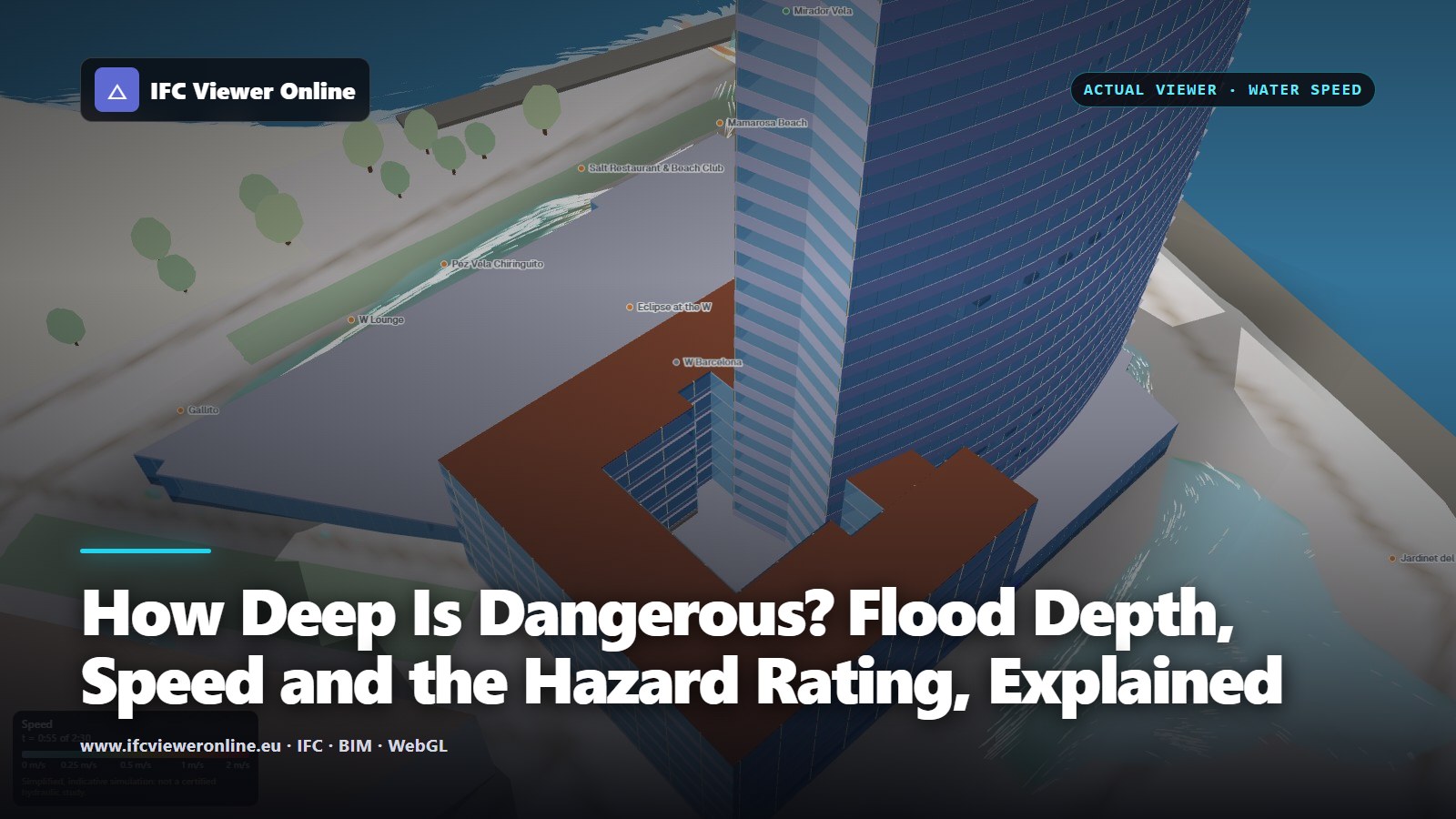 Water speed at the peak of a storm around the W Barcelona hotel IFC, coloured from pale blue for still water to red for fast, with white flow lines
A flood map in shades of blue answers one question: how deep does the water get? The question people actually ask, standing at the door of a building or at the edge of a flooded street, is a different one: is it dangerous? Depth is half of the answer. The other half is how fast the water moves.
Key takeaways
- Depth and speed decide the hazard together: HR = d × (v + 0.5) + DF.
- 15 cm of fast-moving water can knock an adult off their feet; vehicles are swept away in 45–60 cm of flowing water.
- Four classes: caution below 0.75, danger for some up to 1.25, for most up to 2.0, for all above.
- A simulation's maximum depth and maximum speed give a conservative rating, because the two maxima need not coincide.
Try it: how dangerous is this water?
Hazard rating: HR = d × (v + 0.5) + DF
| < 0.75 | Low hazard: caution | Shallow flowing or deep standing water. |
| 0.75–1.25 | Danger for some | Children, the elderly and the infirm. |
| 1.25–2.0 | Danger for most | The general public. |
| > 2.0 | Danger for all | Including the emergency services. |
The hazard rating of Defra / Environment Agency research FD2320, with its precautionary debris factor, or FD2321's by land use. For people outdoors, as a first indication; not for vehicles or structures.Depth is half the answer
The US National Weather Service puts it bluntly: six inches, 15 cm, of fast-moving water can knock an adult off their feet, most vehicles begin to lose contact with the road in the same 15 cm, and vehicles, pickups and SUVs included, can be swept away in 45–60 cm of flowing water[nws]. Standing water at those depths is a nuisance. Moving water at those depths kills people every year.
The reason is physical. Water pushes on whatever stands in it with a force that grows with how deep it is and, much faster, with how fast it moves. A shallow sheet running off a slope can be more dangerous than a deep, still pond.
The hazard rating
UK flood risk work uses a single number for the hazard to people, from Defra and Environment Agency research (FD2320 and FD2321), as clarified in their 2008 supplementary note[ea2008]:
HR = d × (v + 0.5) + DF

d   depth of flooding (m)
v   velocity of the water (m/s)
DF  debris factor (0, 0.5 or 1)
The 0.5 added to the speed is what makes still water count too: even at v = 0, deep water is a hazard. The debris factor accounts for what the water carries.
| Hazard rating | Class | Dangerous for |
|---|
| Below 0.75 | Low hazard: caution | Shallow flowing or deep standing water |
| 0.75 to 1.25 | Danger for some | Children, the elderly and the infirm |
| 1.25 to 2.0 | Danger for most | The general public |
| Above 2.0 | Danger for all | Including the emergency services |
The FD2320 thresholds, recommended for development planning. FD2321 puts "danger for all" at 2.5.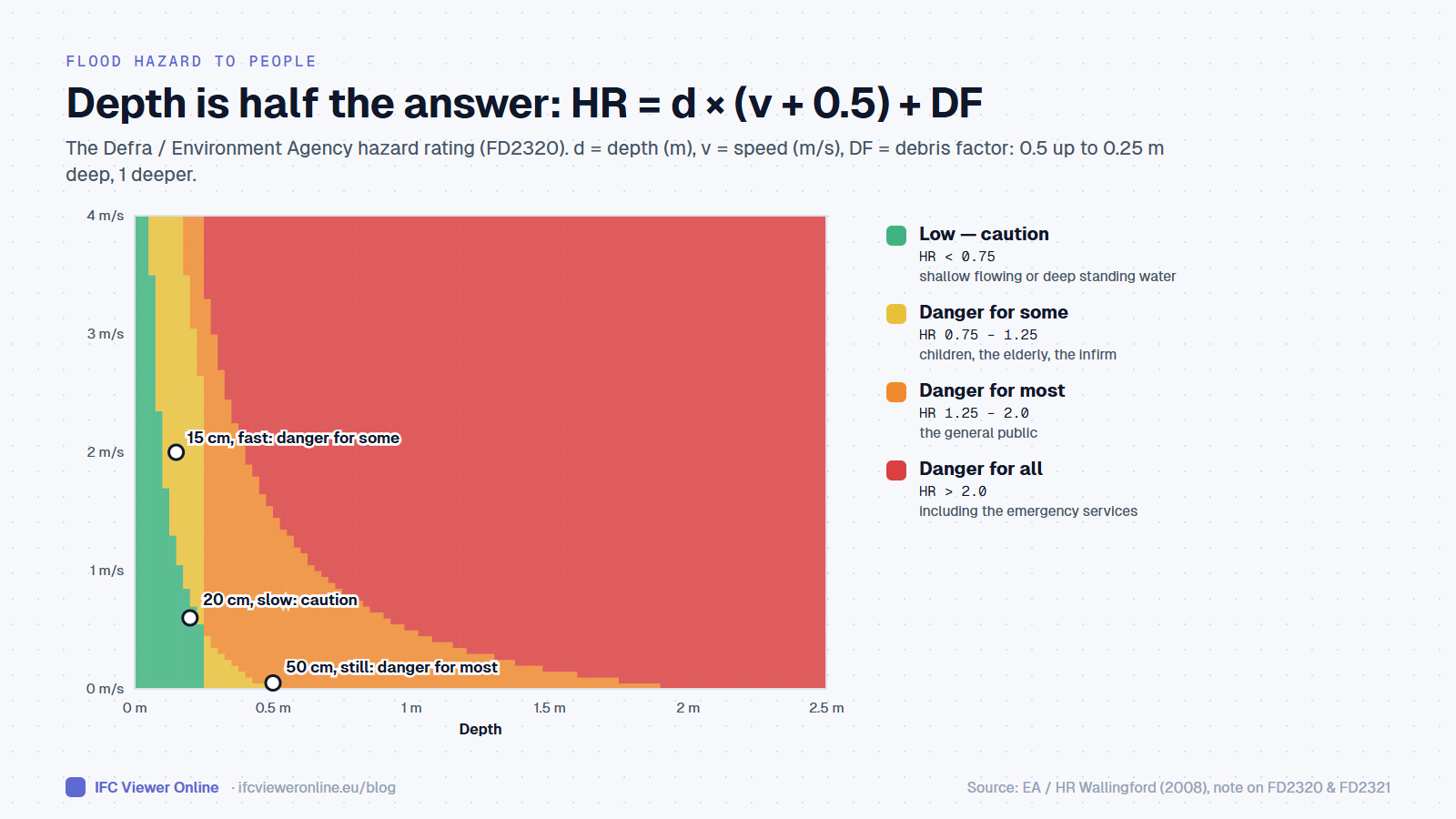 The four zones of the FD2320 hazard rating with its precautionary debris factor. 15 cm moving at 2 m/s is already a danger for some.
The debris factor
FD2320, the guidance for development planning, keeps it simple and precautionary: DF = 0.5 up to 0.25 m deep and 1 deeper, whatever the land use. FD2321 takes the land use into account:
| Depth | Pasture, arable | Woodland | Urban |
|---|
| 0 to 0.25 m | 0 | 0 | 0 |
| 0.25 to 0.75 m | 0 | 0.5 | 1 |
| Deeper than 0.75 m, or faster than 2 m/s | 0.5 | 1 | 1 |
Debris factors by depth, speed and land use (FD2321, Table 3.1).In a town, both give the same answer once the water is deeper than 25 cm. The precautionary version is the one to use when in doubt, and the one the 2008 note recommends for planning.
Reading a flood simulation with it
A simulation gives the depth and the speed in every cell, at every moment. IFC Viewer Online's flood simulation exports two of its maps as GeoTIFF: the maximum depth and the maximum speed over the event. Combining them gives a hazard rating for each cell, but a conservative one, because the deepest moment and the fastest moment of a cell need not be the same moment.
With both files loaded in QGIS as max_depth and max_speed, the raster calculator does it in one expression (FD2320 debris factor, dry cells left at 0):
("max_depth@1" * ("max_speed@1" + 0.5)
  + ("max_depth@1" <= 0.25) * 0.5
  + ("max_depth@1" > 0.25) * 1) * ("max_depth@1" > 0)
Classify the result at 0.75, 1.25 and 2.0 and you have a hazard map. For a single point, such as an entrance or a crossing, use the Probe instead: the timeline replays the event, and the probe gives depth and speed at the same instant.
What the numbers mean around a building
- 5 cm: the simulation's default display threshold. A film of water over paving.
- 10 to 20 cm: over a kerb, up to a door threshold. Enough to get into a ground floor without a step.
- 30 cm and more, standing: a danger for some by the precautionary rating, whatever the speed.
- 50 cm, standing: a danger for most.
- 20 cm moving at 4 m/s: a danger for most, although it would only be "caution" if it stood still.
Next to a building, the question is also whether the water reaches its openings. The simulation compares the highest water next to each door, access, space and piece of equipment with its lowest point, and lists the ones below it.
Limits
- The rating is for people outdoors, as a first indication. FD2321 goes on to weigh how vulnerable the people and the area are; the rating alone does not.
- Vehicles and structures have their own, different thresholds.
- It is UK research. Other countries use other curves on the same two axes; Australia's national guidance, for example, has six classes, H1 to H6.
- A rating from maximum depth and maximum speed overestimates where the two peaks happen at different times.
Check yourself
20 cm of water moving at 4 m/s, with the precautionary debris factor: which class?
- Low hazard: caution
- Danger for some
- Danger for most
- Danger for all
HR = 0.2 × (4 + 0.5) + 0.5 = 1.4, between 1.25 and 2.0: a danger for most.
Why is a rating from the maximum depth and the maximum speed conservative?
- The formula overestimates on purpose
- The two maxima can happen at different moments
- The debris factor is always 1
Each map keeps a cell's worst value over the whole event. Combining two worst values that came at different moments gives a rating higher than any real instant.
According to the US National Weather Service, how much fast-moving water can knock an adult off their feet?
Six inches, about 15 cm, of fast-moving water.
How Deep Is Dangerous? Flood Depth, Speed and the Hazard Rating, Explained